High-Index Lenses: Are They Worth It for Strong Prescriptions?
Contents
If you have a strong prescription, you know the drill: thick lens edges, heavy glasses that slide down your nose, and eyes that look smaller behind the lenses. One of the best fixes is high-index lenses.
What is refractive index?
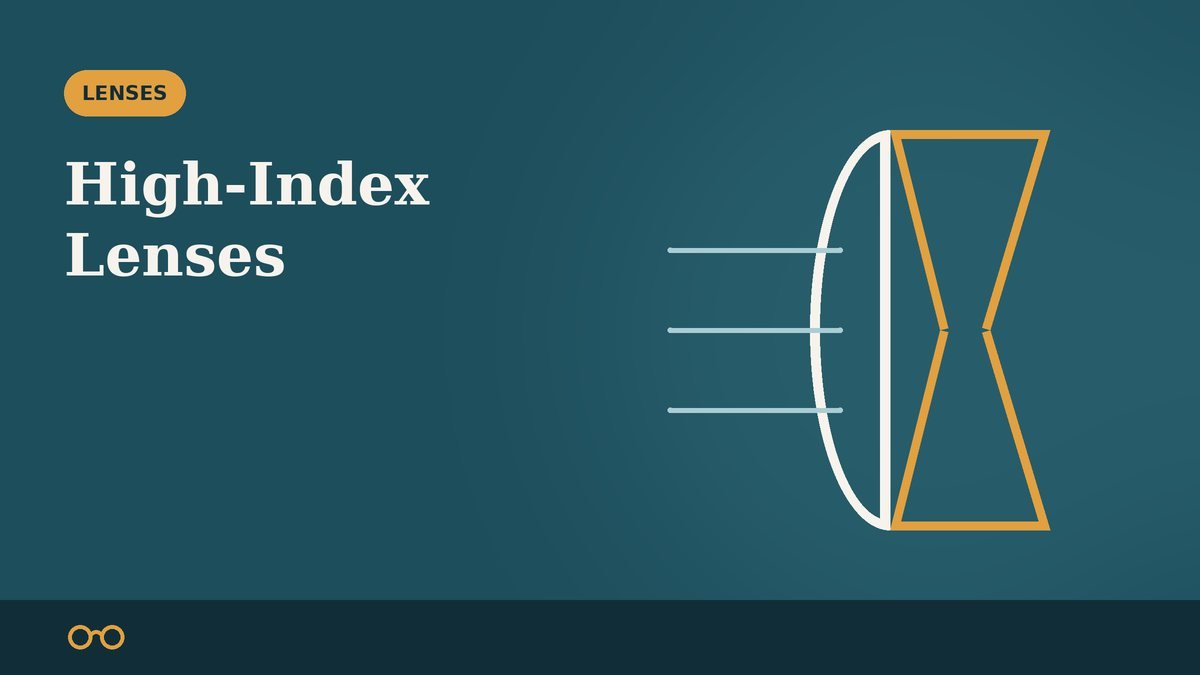
Refractive index describes how strongly a material bends light. The higher the index, the less material you need to reach the same lens power — so the lens ends up thinner.
| Index | Common material | Good for |
|---|---|---|
| 1.50 | CR-39 (standard plastic) | Mild prescriptions, up to about ±2.00 |
| 1.53 | Trivex | Kids, sports, rimless frames |
| 1.56 | Mid-index | Mild to moderate prescriptions |
| 1.59 | Polycarbonate | Kids, sports, safety glasses |
| 1.60 | High-index | About ±2.00 to ±4.00 |
| 1.67 | High-index | About ±4.00 to ±6.00 |
| 1.74 | Ultra high-index | Above ±6.00 |
These ranges are general guidelines. Frame size, PD, and astigmatism also affect final thickness.
Benefits of high-index lenses
- Thinner — the edges of strong minus lenses can be much thinner than with 1.50.
- Lighter — more comfortable all day and less likely to slide down.
- Better looks — the “shrunken eye” effect of minus lenses (or magnified eyes with plus lenses) is reduced, and you can choose from more frames.
What to know before you buy
Abbe value
Abbe value measures how little a lens splits light into colors. The higher the number, the clearer your peripheral vision. High-index materials usually have a lower Abbe value than CR-39 (about 58), so some people notice slight color fringes toward the edge of their vision. Polycarbonate sits around 30. Most people aren’t bothered by it.
More reflections
High-index materials reflect more light. That’s why high-index lenses are almost always paired with an anti-reflective coating.
Cost
The higher the index, the higher the price. For milder prescriptions, the difference in thickness between 1.60 and 1.74 is barely noticeable, so the highest index isn’t always the best choice.
Other ways to get thinner lenses
- Choose a small-to-medium frame where your PD sits close to the lens centers.
- Go full-rim with acetate to hide the lens edges.
- Skip rimless frames for strong minus prescriptions — the edges are on full display.
- Aspheric designs make lenses flatter and thinner, especially for plus prescriptions.
See also how to choose frame size and the right frame material.
The bottom line
High-index lenses are well worth considering for prescriptions around ±4.00 and stronger. For milder prescriptions, a 1.56–1.60 lens in the right frame often looks great and costs less.