How to Read Your Glasses Prescription: SPH, CYL, AXIS, ADD, and PD
Contents
After an eye exam you usually get a prescription full of abbreviations and numbers. To many people it looks like a secret code, but each number has a fairly simple meaning.
OD and OS: right and left eye
OD (oculus dexter) means right eye and OS (oculus sinister) means left eye. Some opticians simply write R and L.
SPH (sphere): minus or plus
SPH is the lens power in diopters (D). A minus (−) sign means nearsightedness (myopia): distant objects look blurry. A plus (+) sign means farsightedness (hyperopia). The bigger the number, the stronger the lens.
CYL and AXIS: astigmatism
CYL is the power that corrects astigmatism, a condition where the cornea or lens is not evenly curved, so lines look smeared or doubled. AXIS is the orientation of that correction in degrees (0–180). The axis does not say how strong the astigmatism is — only its direction.
ADD: extra power for reading
ADD appears on prescriptions from around age 40. It is the extra power needed for reading distance, used in readers, bifocals, or progressive lenses.
PD: pupillary distance
PD (pupillary distance) is the distance between the centers of your pupils in millimeters. It makes sure the optical center of each lens sits right in front of your pupil. If it is off, glasses can cause headaches even with the right prescription.
Example
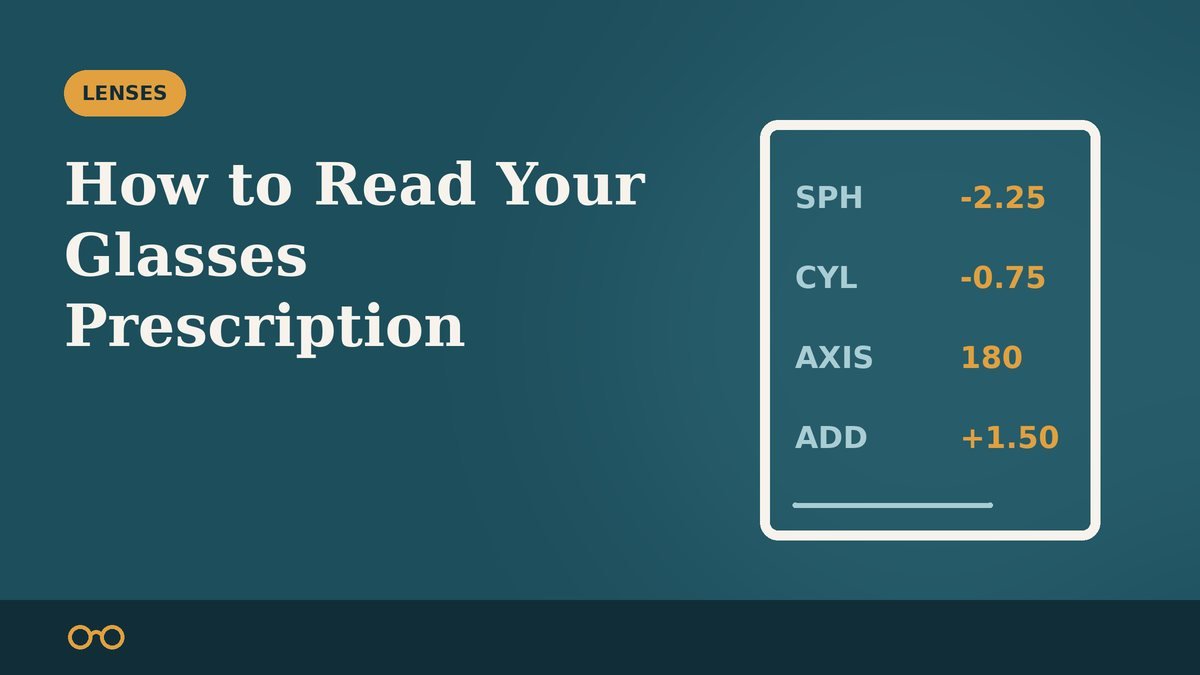
Say your prescription reads OD: SPH −2.25 CYL −0.75 AXIS 180. Your right eye needs −2.25 with 0.75 of astigmatism correction at 180°. If you also see ADD +1.50, you need an extra 1.50 diopters for reading.
Good to know
- Glasses and contact lens prescriptions are different; do not swap them.
- Get your eyes checked every 1–2 years, or more often for children and adults over 60.
- If your prescription is stronger than −4.00 or +4.00, ask about high-index lenses for a thinner result.