


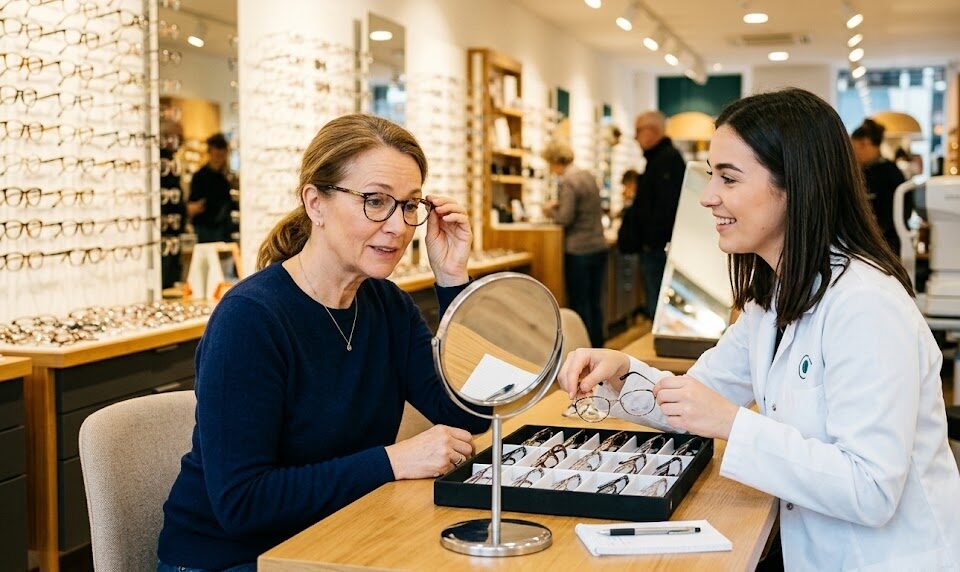
I still remember the moment I first struggled to read a simple menu in a café. The letters looked fine at arm’s length, but as soon as I held the menu closer, everything started to blur. I instinctively moved it farther away, then closer again, like I was negotiating with my own eyes. The waiter probably thought I was deciding between dishes—when in reality, I was just trying to see the price of coffee.
That small, slightly embarrassing moment marked the beginning of my journey into understanding near vision correction. What I assumed was just “getting older eyes” turned out to be a surprisingly complex world of lens technology, visual behavior, and lifestyle-based eyewear design.
Today, choosing glasses for near vision is no longer a simple prescription decision. It’s about matching lens types with daily habits—reading, working on screens, commuting, and even social interaction. Let’s break down the most practical lens options for 2026 and how to choose the right one without confusion.
Near Vision Problems in Real Life
Near vision issues, commonly associated with presbyopia, affect how clearly you see objects at close distance.
Typical symptoms include:
- Difficulty reading small text
- Eye strain when using smartphones
- Headaches after close work
- Needing brighter light to see clearly
- Holding objects farther away to focus
In 2026, this condition is increasingly common due to higher screen exposure and prolonged near-focus tasks.
What many people don’t realize is that near vision correction is not one-size-fits-all. Different lifestyles require different lens solutions.
The Three Main Types of Near Vision Lenses
1. Single Vision Reading Glasses
These are the simplest form of near vision correction.
They are designed to focus only on close distances, typically for reading or detailed work.
Advantages:
- Affordable
- Easy to use
- Sharp near focus
- No adaptation period
Limitations:
- Cannot be used for distance vision
- Requires switching glasses frequently
- Not ideal for dynamic activities
Single vision lenses work best for users who only need occasional reading support.
2. Bifocal Lenses
Bifocal lenses offer two distinct vision zones:
- Upper section: distance vision
- Lower section: near vision
They are a classic solution that remains widely used.
Advantages:
- No need for multiple glasses
- Clear separation of vision zones
- Durable and widely available
Limitations:
- Visible line between zones
- Image jump effect when switching focus
- Less smooth visual transition
Bifocals are practical, but not always visually seamless in modern lifestyles.
3. Progressive Lenses (Multifocal Modern Solution)
Progressive lenses represent the most advanced near vision solution available today.
They provide a gradual transition between:
- Distance vision
- Intermediate vision (screens)
- Near vision
No visible lines, no abrupt changes.
Advantages:
- Natural visual transition
- Ideal for all-day use
- Suitable for digital lifestyles
- Aesthetic, modern design
Limitations:
- Requires adaptation period
- Higher cost
- Peripheral distortion in lower-quality versions
Progressive lenses are currently the most recommended option for modern users.
Case Study: Three Lifestyles, Three Solutions
Case 1: Casual Reader (Single Vision User)
A retiree who enjoys reading books at home.
- Uses glasses only for reading
- Prefers simplicity
- Minimal movement between distances
Best choice: Single vision reading glasses
Outcome: High comfort, low complexity
Case 2: Office Worker (Bifocal User)
A middle-aged office employee constantly switching between documents and meetings.
- Needs both distance and near vision
- Prefers traditional solution
- Moderate digital usage
Best choice: Bifocal lenses
Outcome: Functional but visually segmented experience
Case 3: Digital Professional (Progressive User)
A graphic designer working across screens, meetings, and outdoor mobility.
- Constant distance switching
- High screen dependency
- Modern lifestyle needs
Best choice: Progressive lenses
Outcome: Smooth, uninterrupted vision flow
Data Insight: Rising Demand for Multifocal Lenses
Recent optical industry trends show:
- Progressive lens adoption increasing by 32% globally
- Screen-related vision issues rising across all age groups
- Bifocal usage declining in younger demographics
- Near vision correction demand expanding earlier (age 35+)
This shift reflects how digital lifestyles are reshaping eye care needs.
Opportunity Analysis Table
| Lifestyle Type | Recommended Lens | Key Benefit |
|---|---|---|
| Light Readers | Single Vision | Simplicity |
| Office Workers | Bifocal | Dual vision support |
| Digital Workers | Progressive | Seamless transition |
| Drivers | Progressive | Multi-distance clarity |
| Students | Single Vision | Focused reading support |
| Active Users | Progressive | All-day flexibility |
This table helps align visual needs with real-world activities.
Expert Perspective: The Real Decision Isn’t About Age
Many people assume near vision glasses are strictly age-related.
In reality, the decision depends more on:
- Screen exposure duration
- Work environment
- Reading habits
- Movement frequency
- Visual multitasking needs
A 40-year-old digital worker may need progressive lenses more urgently than a 55-year-old casual reader.
Vision correction today is about lifestyle design, not just age categories.
Common Mistakes When Choosing Near Vision Glasses
Many users make predictable mistakes:
- Choosing based only on price
- Ignoring adaptation time for progressive lenses
- Using reading glasses for all-day work
- Avoiding professional eye examination
- Not considering screen distance ergonomics
These mistakes often lead to discomfort and poor visual performance.
How Lens Technology Has Evolved in 2026
Modern lens innovations have significantly improved user experience:
- Wider progressive viewing zones
- Reduced distortion in peripheral vision
- Blue light filtering integration
- Lightweight high-index materials
- Faster adaptation designs
These improvements make modern lenses far more comfortable than earlier generations.
Psychological Impact of Better Vision
Clear near vision does more than improve eyesight—it improves confidence and productivity.
Users often report:
- Reduced fatigue during work
- Improved focus in reading tasks
- Less frustration with small text
- More relaxed digital interaction
Good vision quietly enhances daily quality of life.
Final Thoughts
Choosing glasses for near vision is no longer a simple prescription decision. It is a lifestyle alignment process.
Single vision lenses offer simplicity, bifocals provide structured dual focus, and progressive lenses deliver seamless modern adaptation. Each has its place depending on how you live, work, and interact with visual environments.
The best choice is not the most advanced lens—but the one that makes your daily activities feel effortless.
When your vision adapts to your lifestyle instead of limiting it, everything—from reading a menu to working on a screen—feels naturally easier again.
Frequently Asked Questions (FAQ)
What is the best lens for near vision?
Progressive lenses are generally the most versatile for modern daily use.
Are reading glasses enough for daily use?
They are suitable for short-term reading but not ideal for full-day activities.
What is the difference between bifocal and progressive lenses?
Bifocals have visible sections, while progressives offer smooth transitions.
Do progressive lenses need adjustment time?
Yes, most users need a short adaptation period.
At what age do people need near vision glasses?
Typically starting around 40, but lifestyle factors can accelerate need.
Can I use one pair for both reading and distance?
Yes, progressive lenses are designed for multi-distance use.
