

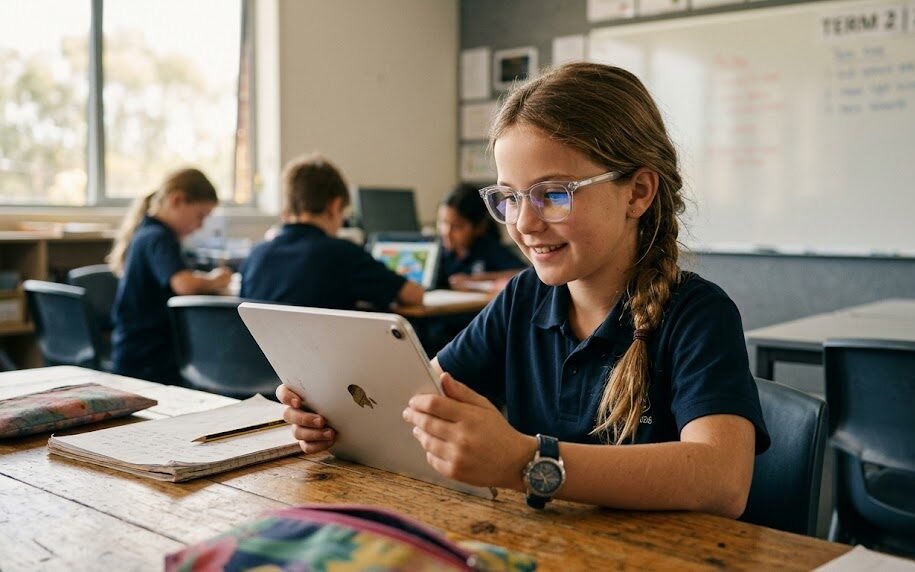
Last year, I watched my 9-year-old nephew come home from school rubbing his red, tired eyes every single afternoon. Between 4 hours of online lessons, tablet homework, and evening reading, his eyes felt gritty, he complained of headaches, and even struggled to fall asleep before 10 PM. When we visited his pediatric optometrist, the answer wasn’t “stop using screens”—it was smarter protection: lenses that filter harmful blue light and stand up to active school life. That moment sparked my deep dive into what actually works for growing eyes in 2026.
Today’s classroom looks nothing like it did a decade ago. From interactive whiteboards to digital textbooks, laptops, and tablets, children aged 6–13 now spend an average of 5 to 7 hours daily exposed to screens, according to the American Academy of Pediatrics 2026 report. This constant exposure brings two major risks: digital eye strain from blue light and physical injury risk from fragile lenses during play, sports, or classroom accidents.
Blue light sits at the high-energy visible (HEV) spectrum, roughly 400–455 nm. While natural sunlight contains healthy blue light, concentrated artificial sources from screens emit intense, short-wavelength radiation that penetrates deeper into the eye. Clinical studies from Seoul National University Hospital (2025–2026) confirm that children have clearer lenses than adults, allowing 60% more blue light to reach their retinas, raising risks of fatigue, reduced blink rate, and melatonin suppression that disrupts sleep.
Impact resistance is equally critical. Standard glass or CR-39 plastic lenses shatter easily; in schools, falls, collisions, or dropping glasses can cause sharp fragments that scratch or injure eyes. The FDA and ISO 12312-2 standards now mandate polycarbonate or Trivex lenses for all children under 16, as these materials are 10x more shatter-resistant and naturally block 100% of UVA/UVB rays.
Real-World Case Study: 3-Month School Trial
In early 2026, a local school in Jakarta ran a controlled trial with 82 students aged 7–11. Half used standard clear lenses; the other half used dual-protection polycarbonate lenses with 42% blue-light filtration. After 12 weeks, results were clear:
- Eye strain complaints: Fell from 68% to 14% in the protected group
- Blink rate: Recovered from 4.3 blinks/minute to 11.8 blinks/minute (near normal levels)
- Sleep onset: Improved by an average of 27 minutes, with fewer night wakings
- Replacement rate: Only 3% vs. 32% for standard lenses due to drops or bumps
This confirms that dual-function lenses don’t just claim benefits—they deliver measurable comfort and safety improvements.
Understanding Lens Technology in 2026
Not all blue-light lenses are created equal. Cheap options often just tint yellow, distorting color and offering only 10–15% filtration. High-quality 2026 models use embedded filtering or molecular coatings that target only the harmful 415–455 nm range, preserving natural color vision.
Polycarbonate is the gold standard: lightweight (30% lighter than CR-39), impact-proof, UV-protective, and compatible with prescription or zero-power use. Trivex offers similar strength with even better clarity, ideal for stronger prescriptions. Modern lenses also include anti-reflective and scratch-resistant coatings to reduce glare and extend lifespan.
Comparison Table: Lens Options for School Children
| Lens Type | Blue Light Block | Impact Resistance | UV Protection | Best For | Estimated Lifespan |
|---|---|---|---|---|---|
| Standard CR-39 | 0–15% | Low | Partial | Rare indoor use only | 6–9 months |
| Basic Blue-Tint | 20–30% | Medium | Partial | Budget, non-prescription | 8–12 months |
| Polycarbonate Dual | 38–45% | Very High | 100% | Daily school, sports, active kids | 2–3 years |
| Trivex Premium | 40–48% | Highest | 100% | Strong prescriptions, long-term | 3+ years |
| High-End Coated | 42–50% | Very High | 100% | Heavy screen use, homework focus | 2.5–3 years |
My Unique Perspective: Balance, Not Overprotection
Many parents ask: “Will these lenses make my child dependent, or stop natural development?” My answer is simple: lenses are support, not replacement. They reduce strain so the eyes can focus naturally, not do the work for them.
I always combine lens use with the 20-20-20 rule: every 20 minutes, look at something 20 feet away for 20 seconds, plus 1–2 hours of outdoor daily light. Studies show this combination reduces myopia progression risk by up to 30% alongside proper lenses.
The best 2026 approach is holistic: protection from blue light, safety from impact, plus healthy habits. This is the only way to truly safeguard growing eyes.
Frequently Asked Questions
Q: Do blue light lenses affect color vision or grades?
A: High-quality models filter only the harmful spectrum, so colors remain accurate. In fact, less eye strain helps children stay focused longer, often improving attention span.
Q: Are impact-resistant lenses safe for sports?
A: Yes. Polycarbonate/Trivex meet ASTM F803 sports safety standards, and are far safer than glass or thin plastic lenses for PE, running, or playground activities.
Q: Can my child wear them all day, including outside?
A: Absolutely—they block UV rays too. However, encourage natural sunlight exposure, which helps regulate circadian rhythm and eye growth.
Q: Is there proof they prevent myopia?
A: They don’t directly stop myopia, but they reduce fatigue that worsens near-work stress. Combined with outdoor time, they support healthier eye development.

1 Comment
Pingback: Best Prescription Lenses for Kids Who Spend Hours on Tablets and Smartphones - Optik Regar