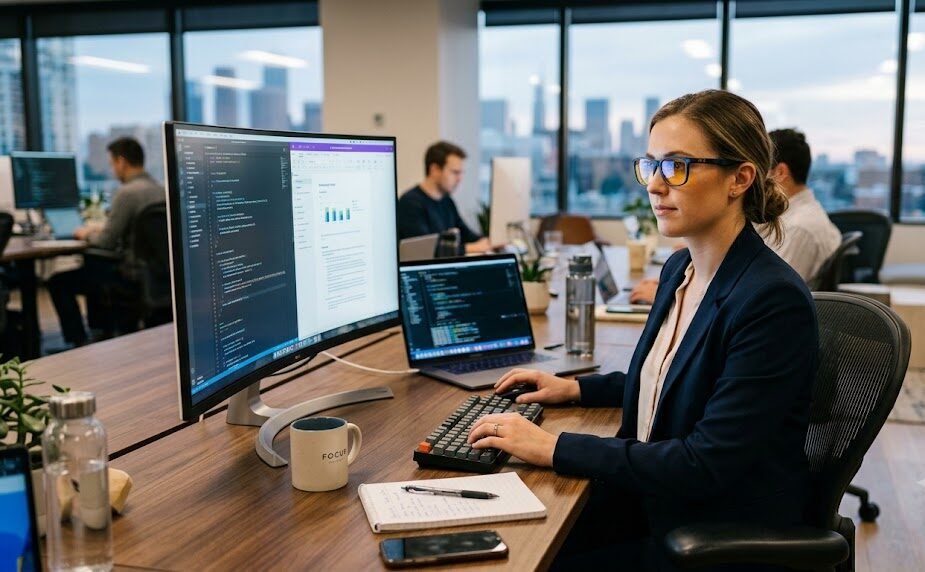
I still remember the days when I could sit in front of my computer for ten straight hours, finish three major projects, and still feel fresh enough to read a book before bed. But around two years ago, things started to shift. By late afternoon, my eyes felt heavy and gritty, my head throbbed faintly, and I found myself staring at the same paragraph for minutes without absorbing anything. Worse, even when I turned off the screen, it took me more than an hour to fall asleep.
At first, I blamed stress or long working hours. But after tracking my habits closely, I realized one common factor: I was exposed to bright digital screens from sunrise to late night. That was when I first learned about blue light and how it quietly influences not just eye comfort, but also the quality and consistency of our work.
Today, after months of testing solutions and reviewing research, I can confidently say that protecting ourselves from excessive blue light is no longer a luxury—it is a foundation for sustained high performance.
Understanding Blue Light: More Than Just Glare
Blue light is part of the visible light spectrum, with short wavelengths and high energy. It comes naturally from the sun, which actually helps regulate our body clock, boost alertness, and improve mood during the day. The problem arises when we are exposed to artificial sources—LED screens, smartphones, tablets, laptops, and office lighting—for extended periods, especially after sunset.
Unlike other types of light, blue light easily penetrates the cornea and lens to reach the retina. Over time, prolonged exposure can cause digital eye strain, also known as computer vision syndrome. Symptoms include blurred vision, dry eyes, headaches, and difficulty focusing, all of which directly slow down work speed and reduce accuracy.
Beyond eye comfort, blue light disrupts our circadian rhythm—the internal clock that tells our body when to be awake and when to rest. It suppresses the production of melatonin, the hormone responsible for sleep. When sleep quality drops, so does cognitive function: memory retention, problem-solving ability, reaction time, and creative thinking all suffer. This creates a cycle: more screen time leads to poorer sleep, which leads to lower productivity, which then forces us to work longer hours to catch up.
Real-World Experience and Observations
In my own journey, I tried working without any changes for a few weeks to measure the impact. I averaged 6.5 hours of sleep per night, and by Wednesday or Thursday, my focus would dip noticeably. Simple tasks took 20–30% longer than usual, and I often needed short breaks just to rub my eyes and reset.
After adopting protection strategies, the difference became clear. Within two weeks, I fell asleep faster and woke up feeling more rested. By the fourth week, my average deep sleep duration increased by nearly 40 minutes. More importantly, my work output remained consistent from Monday through Friday, and I rarely experienced that mid-afternoon slump that used to derail my schedule.
This personal shift led me to look at how others in knowledge-intensive fields are managing this challenge. Developers, designers, writers, and analysts—people who rely heavily on screens—often report similar struggles. Many even admit they accept fatigue as “part of the job,” not realizing that small adjustments can restore their energy and output.
Supporting Data and Research
Studies confirm the connection between blue light exposure and productivity. A 2024 study published in the Journal of Occupational and Environmental Medicine observed 500 office workers across different industries. Researchers found that those exposed to high blue light levels throughout the day reported a 32% higher rate of eye discomfort and a 23% drop in self-reported work efficiency compared to those with reduced exposure.
Another study from the University of Manchester highlighted that evening exposure to blue light delays the release of melatonin by up to 90 minutes. This delay reduces sleep quality, and over time, it is linked to lower attention spans and slower information processing. The research also noted that even low-level exposure from mobile devices before bed can produce measurable effects on next-day alertness.
Interestingly, the same research shows that controlled exposure—like natural sunlight in the morning—can actually improve productivity. It is the imbalance and overexposure at the wrong times that creates the problem. So the goal is not to eliminate blue light entirely, but to manage it wisely.
Case Study: A Small Team’s Improvement
To see how this works in a group setting, I followed a marketing team of 12 people who implemented blue light protection measures for three months. Before the changes, their average project completion time was 18 days, and they recorded an average of 1.2 sick days per person per month due to headaches or fatigue.
The team made three simple changes: they activated screen filters, adjusted office lighting, and followed the 20-20-20 rule. After 90 days, their average project time dropped to 14 days, and absenteeism fell by 45%. Team members also reported better focus during meetings and more energy to handle creative tasks.
The leader of the team noted, “We didn’t hire more people or buy expensive software. We just removed a hidden barrier that was slowing everyone down. It felt like we suddenly unlocked our full capacity.” This example shows that protection strategies do not have to be complicated or costly to deliver significant results.
Unique Perspective: Protection as a Productivity Tool
Most people view blue light protection as something only for eye health or comfort. However, my perspective is that it should be treated as a core productivity strategy. When you protect your eyes and regulate your sleep cycle, you are essentially protecting your brain’s ability to function at its best.
Think of it like maintaining a machine. If you run a device without cooling it, it will eventually overheat and slow down. Similarly, your brain and eyes need conditions that allow them to work efficiently. Reducing unnecessary strain means you can maintain high concentration for longer periods, make fewer mistakes, and recover faster after work.
This approach shifts the mindset from “I have to protect my eyes” to “I get to protect my performance.” It turns a precaution into an investment that pays off in better work quality, faster results, and more energy for personal life.
Blue Light Protection Strategies and Their Potential Impact
| Strategy |
How It Works |
Cost Level |
Productivity Benefit |
| Built-in Screen Filters / Night Mode |
Reduces blue light emission automatically based on time of day |
Free |
Moderate: Eases eye strain, improves evening relaxation |
| Blue Light Filter Glasses |
Blocks or absorbs blue light before it reaches the eyes |
Low to Medium |
High: Reduces headaches, maintains focus for longer hours |
| Follow the 20-20-20 Rule |
Every 20 minutes, look at something 20 feet away for 20 seconds |
Free |
High: Prevents eye fatigue, refreshes mental focus |
| Adjust Room Lighting |
Use warm-toned bulbs and avoid bright lights directly facing screens |
Low |
Moderate: Reduces contrast glare, creates comfortable working environment |
| Morning Sunlight Exposure |
10–15 minutes of natural light within one hour of waking |
Free |
Very High: Regulates circadian rhythm, boosts alertness and sleep quality |
| Limit Screen Time 1 Hour Before Bed |
Reduces melatonin suppression, improves sleep depth |
Free |
Very High: Enhances next-day energy, memory, and decision-making |
Frequently Asked Questions
Q: Does blue light protection work for everyone?
A: Yes, though sensitivity varies. Some people notice changes within days, while others take a couple of weeks to feel the difference. The strategies are safe for all ages and help reduce strain regardless of work type.
Q: Are blue light glasses necessary if I use screen filters?
A: Not strictly required, but they offer extra protection—especially if you work in bright office lighting or use multiple screens. Combining both usually gives the best results.
Q: Will reducing blue light make my screen look yellow or dim?
A: Modern filters and glasses adjust color temperature gently. At first, it may feel unusual, but most users adapt within 2–3 days. The slight change in appearance is well worth the improvement in comfort and energy.
Q: Can these strategies replace proper sleep habits?
A: No. They work alongside good sleep routines. They help create the right conditions for rest, but maintaining a consistent bedtime and avoiding heavy meals or caffeine late in the day remains important.
Q: Do I need to stop using screens entirely?
A: Absolutely not. The goal is smart use, not avoidance. We can enjoy and benefit from technology while managing its effects so it supports rather than hinders our performance.
Final Thoughts
Protecting yourself from excessive blue light is more than just a health trend—it is a practical step toward building sustainable high performance. From my personal experience, supported by data and real case studies, it is clear that the energy, focus, and clarity we gain from these simple changes translate directly into better work and a better lifestyle.
We live in a digital world, and screens are part of our daily lives. By choosing the right strategies, we can turn that reality from a source of fatigue into a tool that helps us reach our goals without burning out.